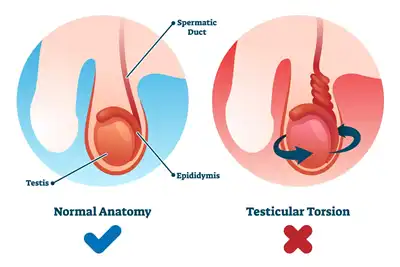
What is Testicular Torsion?
About 1 in 4,000 guys under the age of 25 suffer with testicular torsion, a rare but dangerous disorder that is most prevalent in teenagers between the ages of 12 and 18.
The spermatic cord that provides blood to the scrotum twists and rotates within a testicle, causing torsion of the testicles. The testicle’s blood supply is cut off by the twisting, resulting in abrupt, excruciating pain and swelling. In testicular torsion pain is one of the most noticeable signs. Usually, it happens abruptly on one scrotal side.
What are the Symptoms of Testicular Torsion?
The most common symptom is sudden and severe pain in the scrotum. Other signs include:
- Scrotum swelling
- Testicles positioned above the other
- Color variations in the scrotum, such as redness or darkening
- Noticeable testicular lump
- Stomach pain
- Vomiting and nausea
- Feeling lightheaded
- Frequent need to urinate
- Fever
What causes testicular torsion?
A number of reasons that permit the testis to be detached and freely move inside the scrotum, perhaps twisting, can be the cause of testicular torsion. Among these are a few of these elements:
- Physiological factors: Individuals may occasionally have less taut connective tissue connecting the testicles to the scrotal wall. Testicular torsion may become more likely as a result of this.
- Recently born: Because the connective tissue between the testis and the scrotum is still developing, newborns may also suffer from testicular torsion. This condition might potentially develop prenatally.
- Injury or trauma: Testicular torsion may be more likely in cases of genital trauma or damage, such as severe blows or strikes.
- Physical activity or sports: Testicular torsion has been linked in certain cases to intense exercise, mainly rotational activities. Testicular torsion can be brought on by several kinds of sports and activities, including cycling and sports requiring quick, abrupt movements.
- Young adulthood: Testicular size and shape changes that occur during puberty may have an impact on the likelihood of testicular torsion.
- Testicular torsion in the past: In the event that testicular torsion has already occurred in one testis, it is possible for the other testis to suffer it again.
- Engaging in sexual activities: Sexual activity that involves rotational motions or intensive sexual activity has been linked to some incidences of testicular torsion.
What are the effects of Testicular Torsion on fertility?
Fertility may suffer if testicular torsion is not treated right away. The damaged testicle may require removal if the torsion is not addressed in a timely manner as it may cause tissue death. In particular, if the opposite testicle is also impaired, this may lower sperm production and impair fertility. Furthermore, extended torsion might harm the testicle’s functionality and lower the quality of the sperm even if it is saved. Seldom can testicular torsion cause an inflammatory reaction that affects the contra lateral (opposite) testicle as well, which would further reduce fertility.
How is testicular torsion diagnosed?
Testicular torsion can be diagnosed by a medical professional based on your symptoms, medical history, scrotal ultrasound, and testicular examination. They might promptly recommend that you see a urologist, which is a medical professional who treats diseases of the reproductive and urinary tracts.
What are the treatment options are available for testicular torsion?
Surgery is necessary for testicular torsion (orchiopexy). A surgeon will untwist your testicle during an orchiopexy, which will restore blood supply to the affected area. They will next use stitches to fasten your testicle to an inner wall of your scrotum. By doing this, testicular torsions are avoided.
The surgeon will typically access your scrotum to do surgery, but occasionally, they will need to make a tiny incision through your groin. Torsion typically affects both testicles in people with bell clapper deformities. In this instance, the surgeon will also sew the inner scrotal wall to your undamaged testicle.
Who is At risk for testicular torsion?
There are several categories that are more susceptible to testicular torsion:
- Age: The age range of 12 to 18 is the most common for testicular torsion.
- Previous testicular torsion: Testicular pain that was treated non-medically (intermittent torsion and detorsion) is prone to recur. The likelihood of testicular injury increases with the frequency of discomfort episodes.
- Family history of testicular torsion: The disease may run in families.
- Cold Weather: In certain situations, exposure to low temperatures might set off the torsion reflex in susceptible individuals due to the cremasteric reflex, which causes the scrotum to constrict.
Someone should get medical help right once if they feel threatened or if they have symptoms like sudden, intense testicular pain, swelling, or nausea in order to prevent harmful consequences.
What is can testicular torsion be prevented?
Surgery is the only method to stop testicular torsion. Most people are unaware of their propensity for testicular torsion until they experience it themselves. Your other testicle won’t torsion if you have surgery.
What are the potential complications if testicular torsion is not treated promptly?
Serious consequences may arise if testicular torsion is not treated right away.
- Testicular necrosis: A testicle may perish as a result of inadequate blood flow.
- Infertility: Sperm production can be impacted by testicular damage, which might result in infertility.
- Persistent pain: Even in cases where the testicle is spared, pain and discomfort may persist.
- Distress psychologically: Losing a testicle can have a big psychological effect.
If you believe that you or someone you know is experiencing signs of testicular torsion, you should get medical help immediately.
When I have testicular torsion, what should I expect?
If you receive treatment for testicular torsion as soon as possible within six hours your prognosis is favorable.
On the other hand, your testicle can stop working if there is no blood flow to it for longer than six hours. A surgeon will have to remove it if this occurs.
When should testicular torsion need to be treated?
Testicular torsion is a medical emergency that needs to be treated right away. If treatment is postponed, the afflicted testicle may suffer irreversible harm.
If you believe that you or someone you know is experiencing signs of testicular torsion, you should get medical help as soon as possible. Among these symptoms could be:
- One testicle was suddenly quite painful.
- Testicle swelling in the afflicted area.
- Vomiting and queasy feeling.
- Fever
It’s crucial to get to the closest emergency department if you think you may have testicular torsion.
Why choose Tender Palm IVF & Fertility Center for Testicular Torsion Treatment in Lucknow, India?
Tender Palm IVF & Fertility Center offers best testicular torsion treatment in Lucknow, India. We have an experienced team of fertility specialists and andrologists who use modern technology to diagnose and treat male infertility conditions such as Testicular Torsion. Our team follows international safety standards and has years of experience treating male infertility. We provide accurate evaluation of underlying causes, personalized treatment plans, and minimally invasive procedures with high success rates at an affordable cost. At Tender Palm IVF & Fertility Center, we ensure safe, effective, and result-oriented treatment for male infertility in Lucknow, India.