What are fibroids?
Abnormal growths on or inside the uterus are called fibroids. These tumors can grow to be rather enormous at times, which can result in excruciating stomach pain and heavy menstruation. They usually produce no symptoms at all in terms of indicators. Usually benign or noncancerous, the growths are not harmful. Fibroids have an enigmatic cause.
There are several names for fibroids, including leiomyoma or a myoma, uterine myomas or Fibroids. For women and those assigned to the female gender at birth (AFAB), this is the most prevalent noncancerous tumor
What are the different types of fibroids?
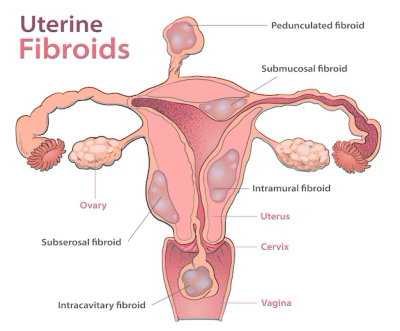
There are several different types of uterine fibroids depending on their location and mode of attachment. The types of uterine fibroids include:
- Intramural fibroids: These are the types of fibroids that are found enclosed within your muscular wall of your uterus. They are the most common type.
- Submucosal fibroids: These fibroids grow under the lining of your uterus.
- Subserosal fibroids: These develop under the uterine lining on the outside. In this case, they can eventually grow into your pelvis and get quite large in size.
- Pedunculated fibroids: These are the least common sort of fibroids, and they have stalks or stems that can attach them to your uterus. These are often referred to like mushrooms because they have the stalk and the wider upper portion.
If you have any of these symptoms and you know you are pregnant, you should get in touch with your doctor right once or seek treatment.
What are the common symptoms of fibroids?
The majority of small fibroids are asymptomatic and don’t require treatment other than routine monitoring by your doctor. You may have several kinds of symptoms from larger fibroids, such as:
- Severe or excessive bleeding when you’re menstruating
- Bleeding excessively in between periods
- Bloating or a sensation of fullness in your lower abdomen.
- Frequently needing to urinate (this may occur when a fibroid press against your bladder).
- Discomfort during intercourse.
- Painful sensations in the lower back.
- Experiencing pressure in your rectum or constipation.
- Continuous vaginal discharge.
- Being unable to urinate or completely empty your bladder.
- An appearance of pregnancy caused by increased size or distention of the abdomen.
Uterine fibroids usually settle or disappear because your body’s hormone levels decrease after menopause.
What causes uterine fibroids?
It is unclear what causes fibroids to form. Several unique factors may influence their growth:
- Hormones, The ovaries produce estrogen and progesterone. These hormones promote the formation of fibroids by allowing the endometrium to regenerate during each menstrual cycle.
- Family history, Fibroids may run in the family. If your mother, sister, or grandmother has had them in the past, you may also have this ailment.
If a person has one or more of the following risk factors, their chance of getting fibroids is increased:
- Fibroids in the family history
- Are 30 years of age or older
- A heavy weight
Additionally, compared to people of other nations, African Americans have a higher risk of developing fibroids.
How can fibroids affect menstruation?
These menstrual problems can occur for a variety of reasons, including interactions between fibroids and the uterus. For example, increased pressure from fibroids can increase uterine bleeding. Additionally, fibroids can promote blood vessel growth, which can lead to heavy bleeding and spotting between periods.
Fibroids can prevent the uterus from contracting after your period, causing prolonged bleeding. To round out the list of possible effects on your menstrual cycle, fibroids can increase levels of prostaglandins, hormones that can cause excessive bleeding.
How do fibroids impact fertility?
5-10% of infertile patients have fibroids. Uterine fibroids may be the only factor contributing to infertility in 1-2.4% of instances. Infertility can result from fibroids because they can obstruct the fallopian tubes and stop reproductive cells from migrating. It is evident that the endometrial cavity’s distortion, which results in aberrant endometrial receptivity, a changed hormonal environment, and altered endometrial growth, maybe the crucial reason. It is unclear, therefore, if fibroids can be the only factor contributing to infertility. This is because few prospective, controlled, and randomized investigations isolate different causes of infertility.
How are fibroids diagnosed?
Most often, fibroids are found by a routine pelvic exam. Your doctor will feel a firm, irregular mass on your abdomen when they press on it during this examination.
Your doctor may recommend one of the following tests to diagnose uterine fibroids:
- Ultrasound of the pelvis: A procedure that employs sound waves to generate images of inner organs by inserting a minute device called a transducer into the vagina or placing it on the abdomen. The doctor can evaluate any lumps and view the size, shape, and texture of the uterus.
- MRI stands for magnetic resonance imaging: A high-tech imaging technology can produce pictures of the inner organs that are amazingly clear. Your provider may be able to use such pictures to locate the exact location and characteristics of fibroids, and even schedule minimally invasive procedures if needed.
- Hysterosalpingus: This type of X-ray examination views the fallopian tubes and the uterus. To make it easier to view these organs and evaluate whether the fibroids have obstructed your fallopian tubes, your physician will administer a special dye.
- Hysteroscopy: This is a view inspection of the uterine cavity and cervical canal employing a hysteroscope, a viewing tool which is inserted through the vagina.
How are fibroids treated?
Based on your age, the size of your fibroids, and your general health, a doctor will create a treatment plan. A combination of treatments might be administered to you.
Natural cures and at-home therapies
On fibroids, a few natural therapies and at-home cures may be beneficial, such as:
- Yoga massage and other acupuncture exercises
- Warm compresses for cramping (avoid heat if you have severe bleeding)
- Dietary adjustments may also be beneficial.
Avoid eating meat and high-calorie meals. Instead, choose for:
- Foods and beverages rich in flavonoids
- Green veggies
- Green tea
- Cold-water fish, like salmon and tuna
If you are overweight, controlling your stress levels and striving for a moderate weight might also be helpful.
Medicines
- OTC (over the counter) pain relievers: This medication helps to alleviate and treat the pain and aches caused by fibroids. Some of the over the counter drugs include; acetaminophen and ibuprofen.
- Iron supplements: Your gynecologist might also tell you to take an iron supplement if you have anaemia due to heavy bleeding.
- Birth control: Menstrual cramps and excessive bleeding during and between periods are some of the symptoms that fibroids cause, and birth control can be helpful for those symptoms. There are various forms of birth control: IUDs, rings, injections, and oral contraceptive tablets.
- Gonadotropin-releasing hormone agonists: These drugs work by making fibroids smaller. They may be used to shrink a fibroid before surgery, so it will be easier to remove. However, the drugs are only temporary, and if you stop using them, the fibroids can come back.
- Oral therapies: A newly approved oral medication, Elagolix, is used to treat heavy uterine bleeding in symptomatic uterine fibroid patients who have not reached menopause. It can be taken for a maximum of 24 months. Discuss the advantages and disadvantages of this therapy with your physician. Another oral medication for the treatment of heavy menstrual bleeding in patients with uterine fibroids is Tranexamic acid.
It is important to discuss any medications you take with your healthcare professional. Before taking a new drug, always speak with your doctor about any potential side effects.
Procedures that are minimally or noninvasive
An entirely non-invasive surgical technique that is relatively new is forced ultrasound surgery. To enable a specialist to see within your uterus, you lie down inside a specialized MRI machine. The fibroids are targeted for ablation, or destruction, using high-energy, high-frequency sound waves.
Myolysis techniques, like Acessa, use heat sources, like an electric current or laser, to shrink fibroids; cryomyolysis, on the other hand, freezes the fibroids. An endometrial ablation procedure involves the insertion of a specialized tool into your uterus by a medical practitioner to destroy the uterine lining with heat, electric current, hot water, or extremely low temperatures.
Uterine fibroid embolization is another nonsurgical approach. During this treatment, small particles are injected into the uterus to stop the fibroids’ blood supply.
Surgery
To remove several or very large growths, you could need surgery. We call this procedure a myomectomy.
An abdominal myomectomy requires a wide abdominal incision to reach the uterus and remove the fibroids. However, it is also possible to execute a myomectomy laparoscopically. A laparoscopic operation involves a few tiny incisions made by the surgeon, through which surgical instruments and a camera are inserted.
Following a myomectomy, fibroids may regrow. A surgeon might do a hysterectomy if your disease gets worse or if there are no other options. Nevertheless, this implies that you will never be able to become pregnant again.
What is the outlook for people with fibroids?
What size and where about your fibroids are will determine how things turn out. If a fibroid is small or doesn’t cause symptoms, it might not require treatment.
A doctor will closely monitor your condition if you have fibroids and are pregnant, or if you become pregnant and have fibroids. Fibroids typically don’t cause issues when pregnant. If you have fibroids and anticipate becoming pregnant, consult a physician.
Why choose Tender Palm IVF & Fertility Center for Fibroids Treatment in Lucknow, India?
Tender Palm IVF & Fertility Center offers the best fibroids treatment in Lucknow, India. We have an experienced team of fertility specialists and gynaecologists who use modern technology to diagnose and treat female fertility conditions such as fibroids. Our team follows international safety standards and has years of experience treating female infertility. We provide accurate evaluation of underlying causes, personalized treatment plans, and minimally invasive procedures with high success rates at an affordable cost. At Tender Palm IVF & Fertility Center, we ensure safe, effective, and result-oriented treatment for female infertility in Lucknow, India.